For context and assumptions and disclaimers, please read this first.
Reading on:
Our session began very quietly. I was in a comfortable chair, Ellie was hanging out on her rug by my feet, having had a walk and a nap. I called Janet, we exchanged a few pleasantries, she asked me if Ellie was present (she didn't actually need to be).
Janet asked if Ellie was slight and I commented she was of slight build, but was a German Shepherd Dog. Janet commented that Ellie was quiet, being reserved, and then Janet started laughing as she got a name 'wild child' (I laughed too). She commented that Ellie was a 'young soul' and quite happy to be a young soul, rather new at being a 'dog soul' and that Ellie thoroughly enjoyed being in her body. She then went on to say that Ellie had little memory of siblings or puppyhood, wondering if maybe she had been taken from her mother quite early. She also said this wasn't an issue for Ellie, it just was what it was. Actually, for Ellie, said Janet, nothing is much of an issue, she's perfectly happy being who she is, she's happy being with us, happy chasing cats, happy doing whatever.
We started talking about the idea of bonding, which apparently is a somewhat novel idea to Ellie, and Janet and I both agreed that this would be unusual for a German Shepherd Dog. I asked Janet two questions: Is Ellie interested in bonding with humans, me specifically, and what emotional residuals might she have from having been given up by her previous people?
Ellie is intrigued by the whole bonding thing, and is willing to give it a try. She is willing to give anything a try, although she's pretty clear she intends to be who she is. Because she wasn't bonded to the people who gave her up, she doesn't seem to be much concerned with what went on before.
That was pretty much the end of the session.
As my husband, the scientist, says, "That isn't really anything that we didn't already surmise." True, but.
What happens next? In my world(one view), what we learn here is a type of information that likely involves perception and imagination that may or may not be useful. How does and can such information from an alternative perspective become a positive influence in our relationship with Ellie?
Sunday, January 10, 2010

Saturday, January 9, 2010
Conversing with the Animal Communicator-Part 1.

If you are curious about animal communicators and how working with an animal communicator might fit in with working and playing with your dog (or other animal), then read on.
As a scientifically trained statistician/poet yogini, I look at working with a good animal communicator as sitting down with a good story. When I want to learn about something, I will usually read non-fiction scholarly works and non-fiction popular works, biographies and auto-biographies. However, I find I learn the most when I read the stories and poems of the people, listen to the music, and engage actively (when possible) with people of the culture.
It's not such a huge step to change the word 'people' into 'beings' and thus step into the story of the animal, in this case, the story of Ellie. Ellie's 'non-fiction' story has two elements, what we know before she came, and then my own observations since her arrival into our multi-species family. Her biography is slim-reading: She was surrendered to the humane society, (I don't know by whom), she's around 3 years old.
I know what I know from my observations - but - I also know that my observations can be 'clouded' from my own experiences (avidya) which is why I practice and study yoga. Working with one's own animals almost invariably involves emotional attachment, which can interfere with clear perception.
It can be helpful to obtain information from other sources, which you can then synthesize with what you already think you know. As with any kind of information, whether it be scientific observation, quantitative statistical analysis, or subjective observation of self, we usually begin with a set of assumptions. Here are the assumptions I make when working with an animal communicator:
1. The animal communicator communicates in human language impressions they receive from the dog - they act as a translator, so the words that are used are to make sense to the person, like interpreting for someone what the poem, "Kublai Khan" means.
2. Animals can communicate with people beyond body language.
3. People and animal communication is not constrained by spatial boundaries.
If I'm not willing to make the assumptions, then it's pointless to work in this modality. But I like exploring different modalities, Ellie and I were give a gift of a session with an animal communicator (Janet, mentioned in the above link) and so I'll report on the actual session in the next post.
Wednesday, December 30, 2009
Does your dog have a doggie mentor?

Spending time with a dog who is more mature and knowledgeable about the dog world, the human world, and the interaction between, seems to help Ellie make a behavioral shift. As a rescue who came to our family with few social skills, I'm always open to whatever might help her make up for lost socialization time.
As an example, 'cousin' Katie came for a sleepover and a rugged day hike. Ellie, who lacks social skills with dogs and humans, was on the receiving end of several snaps, since she didn't recognize (or respond) to Katie's gently escalating calming signals, the lips, the yawn, the eye blink, the teeth, more teeth, more teeth, and then finally an air snap. Eventually, Ellie was able to self-control and lay down (for some minutes anyway) in Katie's presence without feeling a need to try and get Katie to play. We also did a night walk in the neighborhood with Katie and her person.
We've noticed that Ellie is able to spend more time in 'self-control' since Katie's visit. One big example of self-control was on her morning walk, where she did no lunging, and spent at least 80% of the walk on loose leash with check-ins.
When Ellie went to the dog park yesterday, her interactions with the other dogs, Franko and Rusty, were a bit more circumspect than previously. If I had to put a label on it, I'd say she was a little less puppyish.
We noticed a similar behavior shift after Ellie's outing with friend Sarah. Sarah, although supposedly chronologically younger, is more mature-acting than Ellie.
Does your dog need a doggie mentor? Does a friend or acquaintance of yours have a dog that exhibits self-confidence and self-control? Perhaps you can arrange a play-date (we go to the local dog park at off times) or arrange for a neighborhood walk with the dog mentor.
One day, maybe that mentor will be Ellie!
Monday, December 28, 2009
Dog Encounters of the Desert Kind

Ellie is pretty quiet today !?!
Actually, not that much of a surprise, considering that she took 2 hikes in 3 days , had an encounter with an unruly unleashed dog on yesterday's 7 mile hike up the Bug Spring trail, played in snow, drank snow melt, and received instructions in doggie manners from her cousin Katie
(a well-seasoned cattle dog who takes her role as t
 eacher quite seriously).
This was Ellie's first 'sleepover' with another dog. Well, sometimes its hard to think of Katie as another dog, because Katie doesn't think of herself as another dog. She has a job, which is as her peep's outdoor adventure companion. This is a dog who understands 'rock' (get out of the way because a rock has unlodged while a person is climbing a rock wall) and understands that rope is never to be walked on, knows how to boulder scramble (with an occasional spotting) and has even gone on a Tyrolean traverse. (No, that isn't Katie, but I'll find a pic of her doing her traverse.)
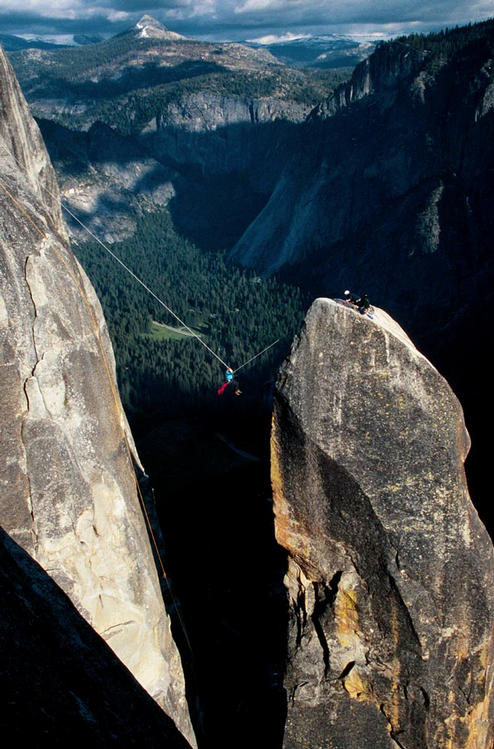
Ellie wanted desperately for Katie to play with her, but that just was not going to happen. We did have some moments where she lay quietly, following Katie's lead. We sent Katie home with some homemade biscuits, beef brownie, and crispy gizzard treats and both dogs slept well after their get together.
Thank you, good girls.
Tuesday, December 22, 2009
Quirky Ellie: Its a process, not an event.
Ellie has some quirks.
I've been working with training dog companions to become service dogs for over five years, and I have to say, Ellie can come up with some stumpers. As my friend and horse rehabber, Stacey Kollman, says, "Ellie is your final exam in using positive reinforcement methods and training dogs following yoga principles."
A little background: Ellie came to us from Central Arizona German Shepherd Rescue. She was surrendered to the animal shelter for the reason of "not having enough time." She is supposed to be 3 years old (although she seems much younger to me), and she was spayed through the shelter. When I went to see her, I tried some click-n-treat, which she picked up within about 4 clicks. She seemed affectionate with Mike, who cares for the GSD rescues, and she jumped right into the car and quietly rode the 2 hours home with me.
And then the fun began. Miss Ellie
It's a process, not an event. There are a lot of behaviors to divert, replace, extinguish, and otherwise address. We've made great progress, and we're having fun.
And for now, she's resting quietly at my feet. Thank you, good girl.
I've been working with training dog companions to become service dogs for over five years, and I have to say, Ellie can come up with some stumpers. As my friend and horse rehabber, Stacey Kollman, says, "Ellie is your final exam in using positive reinforcement methods and training dogs following yoga principles."
A little background: Ellie came to us from Central Arizona German Shepherd Rescue. She was surrendered to the animal shelter for the reason of "not having enough time." She is supposed to be 3 years old (although she seems much younger to me), and she was spayed through the shelter. When I went to see her, I tried some click-n-treat, which she picked up within about 4 clicks. She seemed affectionate with Mike, who cares for the GSD rescues, and she jumped right into the car and quietly rode the 2 hours home with me.
And then the fun began. Miss Ellie
- chased our cats
- loved her kennel from the get-go
- is housebroken
- jumps on people (she's very light on her feet!)
- pulled HARD on the leash, seemed to have no concept of leash walking
- mouths a lot, with little to no bite inhibition (doesn't break skin)
- runs to her kennel when I brush my teeth
- boxes my ankles HARD
- still occasionally goes for 'the takedown' - biting at my ankles and boxing HARD
- would grab the leash and yank HARD at the end of our walks
- leaped and lunged at people, dogs, anything that moved
- had her gentle leader off faster than any dog I've ever worked with!
- lays quietly within about 6 feet if I putter
- gets agitated when I sit in the chair to work on the computer (but not with my husband)-jumps into the chair, grabs my hand or goes for my ankles, noses the computer
- would clicker train 24/7
- ducks her head and flips your hand to under her chin if try to pet anywhere near her head (clever girl, interesting strategy)'
- is all about play (yay - it gives me a key to help her learn to moderate her own behaviors so she's socially acceptable around people and dogs - and - cats)
It's a process, not an event. There are a lot of behaviors to divert, replace, extinguish, and otherwise address. We've made great progress, and we're having fun.
And for now, she's resting quietly at my feet. Thank you, good girl.
Monday, December 21, 2009
The Well-Dressed Clicker Trainer

Your Basic Pupkus Pants: long pants, not recently washed, dark enough not to show doggie drool smears from wiping your hands on your pants. You'll be the most popular person at the dog park, with the dogs.
Shoes of substance: cover the toes, walking shoes best so you can cover plenty of ground, exercise is good for all of us!
Accessorize:
Belly Pack: This is the fanny pack, worn backwards. Preferably with multiple pockets. You have to have room for food rewards, poop bags (always at least 2, so you won't need them), your keys, a toy squeaker, your lip balm, an extra clicker. More food rewards than you think you need. Maybe a hand towel, if you aren't wearing your pupkus pants.
Food Rewards: The best-dressed clickerers have handy an unpredictable mix of flavors, textures, sizes, and smells. Include at least 4 types: kibble, some tiny bits of hot dog (Ellie and I prefer uncured, sliced and quartered), leftover bits of chicken or other meats, maybe a few bits of carrot, gizzard jerky, freeze-dried liver, crispy bread treats (preferably sprouted grain bread, coated in ghee and/or uncured bacon drippings with a few drops of sesame oil), chicken or beef brownie...whatever you take, it needs to be something your dog likes!
Toy Reward: a small tug toy is a nice change if your dog likes them.
Sunday, December 13, 2009
Dog Diet Ruminations and Ellie's Raw Experiment Begins
There's a reason the leftover bag from the restaurant is called a 'doggie bag'. It's my story (and I'm stickin' to it, at least for now), that dogs evolved with us, as our companions, and for many years what they ate was our leavings along with their occasional bunny or bird kill. I wonder, why not feed them that way today? (Although, if we eat junk, then maybe that isn't such a great idea.)
Shortly after Ellie came to our home, I was listening to NPR's Science Friday, taking place at Cornell Veterinary School. The veterinarian on the panel recommended the feeding of quality commercially prepared food because these diets were scientifically formulated to provide a complete food source. I've got to disagree with that veterinarian, if only on the grounds that dogs have the right to a little pleasure with their food along with the rest of us. My disagreement is actually more a matter of degree.
A little background is in order here. Once upon a time, I was an animal scientist, with a few degrees from Purdue University in animal and ruminant nutrition. (I used to be an expert in feeding baby lambs on milk replacer.) I also spent a fair number of years as a researcher in meat science, then in exercise physiology (humans and horses). It's been some years (that's another story), but the animal scientist in me suspects that dog food manufacturers don't conduct taste panels for dogs that include stuff that dogs really like, like road kill, horse manure, or a freshly killed rabbit.
The statistician in me recognizes the need for objective evaluation of data and also recognizes that the value of statistics lies in the ability to generalize to a population of measurements.
The yogini in me is the one that values the subjective experience. Ultimately, whether it's taking aspirin or ingesting a formulation, it comes down to the individual subjective experience.
Ellie has her own subjective experience, one that I can only guess at. However, she's demonstrated to me that she's perfectly capable of making her own decisions. All that to come to this; we are introducing raw into her diet. We are starting slow, to observe changes.
Twice this week she's had a breakfast of a raw turkey wing piece along with some stewed veggies (retrieved from the carcass brownie cookdown). I chopped the first wing up a bit, but realized that wasn't necessary, as Ellie very methodically breaks down the bones in her jaws before eating, rather than trying to wolf it down whole. She likes it, she doesn't get grabby about it, and her poops are smaller, white, more like coyote scat. So far, so good, from Ellie's preference perspective.
She still gets dinner that is commercial food (Trader Joes Bench and Field) with leftovers, her clicker treats are a mixture of what I prepare (crispy gizzard jerky, freeze dried liver, grease bread treats, carcass or meat brownies and biscuits) and treats I pick up on sale, that have the fewest ingredients.
Aside: Isn't it interesting that there is an inverse correlation of the number of ingredients to cost in commercially available dog treats? Watch the movie Food, Inc. to learn why the cheap foods are so cheap (NOT!).
Shortly after Ellie came to our home, I was listening to NPR's Science Friday, taking place at Cornell Veterinary School. The veterinarian on the panel recommended the feeding of quality commercially prepared food because these diets were scientifically formulated to provide a complete food source. I've got to disagree with that veterinarian, if only on the grounds that dogs have the right to a little pleasure with their food along with the rest of us. My disagreement is actually more a matter of degree.
A little background is in order here. Once upon a time, I was an animal scientist, with a few degrees from Purdue University in animal and ruminant nutrition. (I used to be an expert in feeding baby lambs on milk replacer.) I also spent a fair number of years as a researcher in meat science, then in exercise physiology (humans and horses). It's been some years (that's another story), but the animal scientist in me suspects that dog food manufacturers don't conduct taste panels for dogs that include stuff that dogs really like, like road kill, horse manure, or a freshly killed rabbit.
The statistician in me recognizes the need for objective evaluation of data and also recognizes that the value of statistics lies in the ability to generalize to a population of measurements.
The yogini in me is the one that values the subjective experience. Ultimately, whether it's taking aspirin or ingesting a formulation, it comes down to the individual subjective experience.
Ellie has her own subjective experience, one that I can only guess at. However, she's demonstrated to me that she's perfectly capable of making her own decisions. All that to come to this; we are introducing raw into her diet. We are starting slow, to observe changes.
Twice this week she's had a breakfast of a raw turkey wing piece along with some stewed veggies (retrieved from the carcass brownie cookdown). I chopped the first wing up a bit, but realized that wasn't necessary, as Ellie very methodically breaks down the bones in her jaws before eating, rather than trying to wolf it down whole. She likes it, she doesn't get grabby about it, and her poops are smaller, white, more like coyote scat. So far, so good, from Ellie's preference perspective.
She still gets dinner that is commercial food (Trader Joes Bench and Field) with leftovers, her clicker treats are a mixture of what I prepare (crispy gizzard jerky, freeze dried liver, grease bread treats, carcass or meat brownies and biscuits) and treats I pick up on sale, that have the fewest ingredients.
Aside: Isn't it interesting that there is an inverse correlation of the number of ingredients to cost in commercially available dog treats? Watch the movie Food, Inc. to learn why the cheap foods are so cheap (NOT!).
Subscribe to:
Posts (Atom)